Retail vs. White-Label on Amazon: A Complete Guide to Listing and Catalog Automation
Compare retail reselling and white-label selling on Amazon, and learn how catalog automation can simplify ASIN matching, product creation, browse-node mapping, and multi-store management.
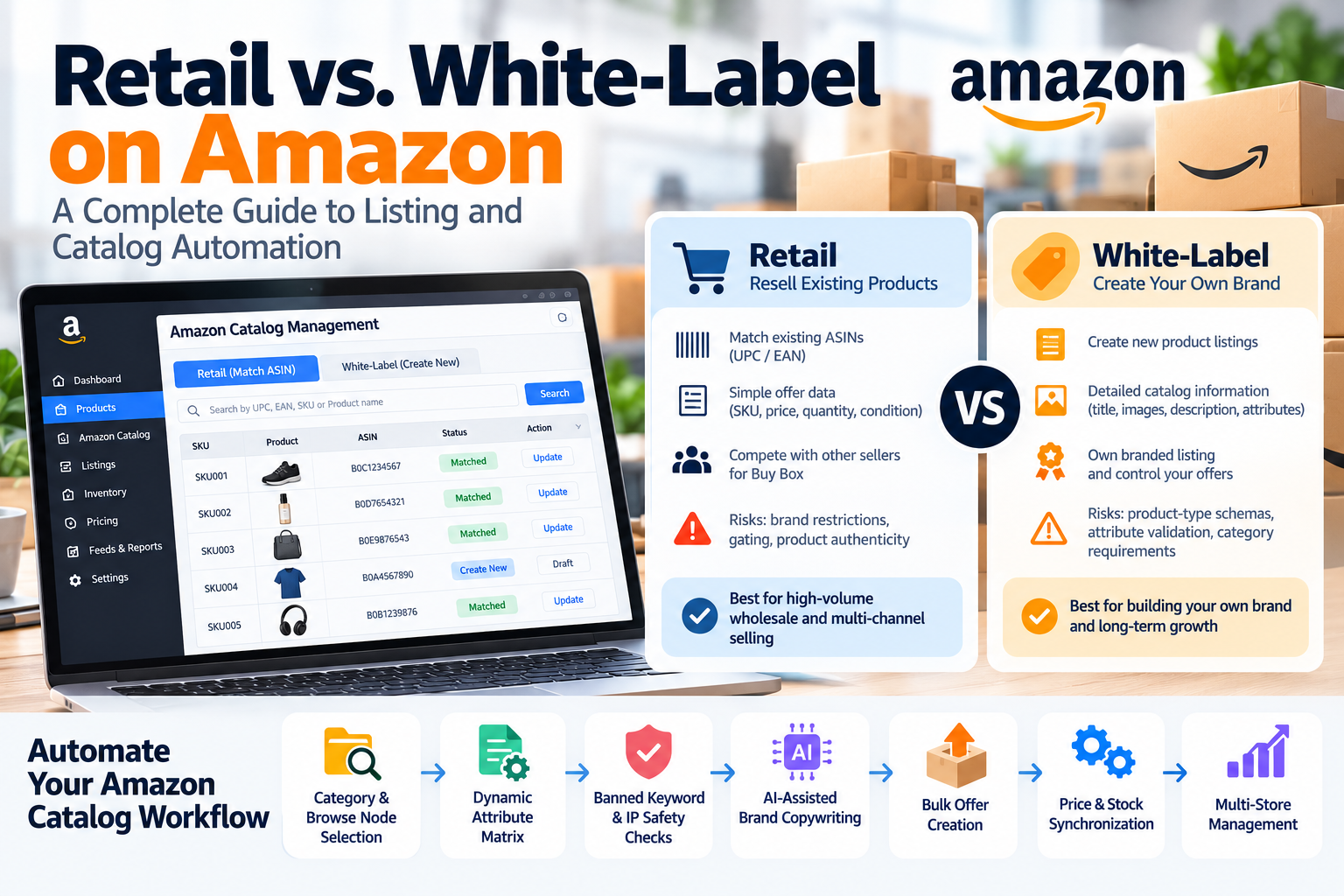
Retail vs. White-Label on Amazon
Whether you are scaling a retail or wholesale business or building a private-label brand, your Amazon catalog strategy depends heavily on your business model.
Retail and white-label selling have different listing requirements, catalog workflows, competition structures, and operational challenges.
Understanding these differences can help sellers choose the right catalog and automation approach for their business.
Key Differences Between Retail and White-Label
1. Listing Process
Retail sellers generally match existing product information, such as UPC or EAN barcodes, to existing Amazon ASINs.
White-label sellers typically create new product listings and establish their own branded product catalog.
2. Data Requirements
Retail offers may require relatively simple offer information such as:
- SKU
- Price
- Quantity
- Condition
White-label products generally require more detailed catalog information, including:
- Product title
- Bullet points
- Product images
- Product description
- Category
- Browse node
- Brand information
- Product-type attributes
3. Competition
Retail sellers may compete with multiple sellers offering the same ASIN and can compete for the Buy Box.
White-label sellers generally operate their own branded product listings and control their own offers for those products.
4. Primary Operational Risks
Retail sellers may encounter challenges related to brand restrictions, gating, product authenticity, and intellectual-property requirements.
White-label sellers may face challenges related to product-type schemas, category requirements, attribute validation, and discovering relevant search terms.
How to Automate White-Label Product Launches
1. Category and Browse Node Selection
An automated system can retrieve Amazon's category hierarchy and browse-node information to help sellers identify the appropriate category for a new product.
2. Dynamic Attribute Matrix
The platform can generate forms and templates based on the relevant Amazon product-type schema.
For example, depending on the product category, the system may dynamically request attributes such as:
- Material composition
- Closure type
- Target gender
- Product dimensions
- Product specifications
3. Banned Keyword and IP Safety Checks
Automated validation can scan listing content against configured restricted terms and safety rules before publishing.
This provides an additional review step before product information is submitted to Amazon.
4. AI-Assisted Brand Copywriting
AI can assist sellers in creating product descriptions and feature bullets that are structured for marketplace search visibility while remaining readable and useful for customers.
How Retail Sellers Benefit from Automation
Bulk Offer Creation
Retail sellers can match large numbers of product identifiers to existing Amazon ASINs without manually completing lengthy product-attribute forms for every product.
Price and Stock Synchronization
A centralized platform can synchronize pricing and inventory information across connected stores from a single management interface.
Clean Data for Repricing
Keeping catalog, price, and inventory data synchronized gives repricing systems more reliable information when managing competitive offers.
Which Model Fits Your Business?
Retail Automation
Retail automation can be suitable for businesses focused on:
- Fast SKU processing
- Wholesale inventory
- High-volume product management
- Multi-channel selling
- Existing ASIN-based offers
White-Label Automation
White-label automation can be suitable for businesses focused on:
- Building their own brand
- Creating custom products
- Managing product variations
- Developing long-term product catalogs
- Controlling their own branded listings
Summary
Retail and white-label businesses have different catalog and listing requirements, but both can benefit from centralized automation.
A powerful multi-marketplace platform can help sellers manage existing retail offers while also supporting the more detailed workflows required for launching and managing white-label products.
By combining centralized catalog management, dynamic Amazon schemas, automated validation, and AI-assisted content generation, sellers can manage different product models from a single dashboard.
Ready to automate your catalog & inventory in real time?
SellerBuz synchronizes stock across Amazon FBA & FBM with AI-powered listing tools.